

The Season of Creation is an ecumenical liturgical season celebrating the sacredness of creation and the human responsibility to live with care and justice on it’s behalf.
Feast of Creation in Christ - Ecumenical Worship Gathering
Saint Andrews Episcopal Church, Seattle
1 September 2026

Written Reflections on Faith, Creation & Care
The Feast of Creation (Sept 1) begins a liturgical season focused on the sacredness of the natural world and our responsibility to work for it’s wellbeing. In 2026, the Feast of Creation in Christ expanded beyond it’s Orthodox Christian feast day to an ecumenical one, as it was formally included in the Revised Common Lectionary. ( we can link to the RCL: The Consultation on Common Texts). Local PNW theologians and leaders offer their reflections on the annual theme of the Season of Creation, and we invite you to explore and include these unique liturgical offerings in your own community.

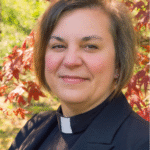
Author: Rev. Dr. Kara Markell
I grew up in Minnesota, the land of 10,000 lakes. Water in abundance. Summers were lived in communion with water – fishing in the Minnesota River, swimming in Duck Lake, tubing on the Pelican River. In Lake Itasca State Park I walked across the headwaters of the Mississippi River in just a few steps. This water life formed me.
The water of the Pacific Northwest has continued to form me through its gentle rain and mists, in the flowing streams around Lake Washington, in the crystal-clear alpine lakes of təqʷuʔməʔ (Tahoma/Mt. Ranier).
To be immersed in this living, sacred water is to care deeply about it, to know that my life and the lives of all beings in my ecosystem depend on it. It does not allow us to hold an extractive posture, seeking only what we can use. To appreciate water as simply a resource to be used, misses the reality that water is a living presence that holds and heals.
The guiding scripture for this year’s Season of Creation – Ezekiel 47.9,12 – reminds us that living water flows from the place where God resides. And doesn’t God reside everywhere, in all places? Many traditions affirm that the divine reveals itself through the physical earth, in the sky, wind, mountains, living creatures and in water. Therefore, all water must inherently be sacred, and all those who depend on and interact with water must revere it – its power, refreshment, and sustenance. Water is life. And the waters that have formed me taught me to honor and protect it so that it can sustain our bodies, our communities, and the generations to come.
Rev. Dr. Kara Markell
Christian Church (Disciples of Christ)
Assistant Director, CEIE
Spiritual Guide, Evergreen Wild Church

Author: Rev. Laura Baumgartner
Jump in!
My church offers a camp each year for youth in our neighborhood, on the shores of a lake. During camp in the morning, we provide back-to-school refreshers in math and reading. In the afternoon, we get in the water. There are lifeguards and life jackets, so we stay safe and paddleboards, kayaks, a rowboat, a canoe, and a dock for sunbathing and jumping into the water. The campers know how far out into the water they are allowed to go and how to get back to camp if they get turned around while swimming. The water forms a physical boundary to the campgrounds, yet it also functions as a shared learning experience, a creative space for multi-generational connection, and a source of joy when we are immersed in it.
The focal text for this year’s Season of Creation is Ezekiel 47, in which God shows the prophet a rising river and bids him walk through it several times, to become immersed in its waters, until it is too deep to cross easily. God explains that this river forms the physical boundary for the land where his people will reside. However, the boundary is not a rigid one. There is a provision for those who will cross in and out of the land through the river, as well as the river itself. The waters form not just a physical boundary but also a shared acknowledgement of responsibility for neighbor and faithful stewardship of land, water, and air.
In this season, may we know the joy of playing in the water. Further, may we be immersed in the waters of our faith, knowing the boundaries of what God has created and offered and accepting responsibility for its well-being.
Rev. Laura Baumgartner
Christian Church (Disciples of Christ)
Pastor, Haller Lake United Methodist Church
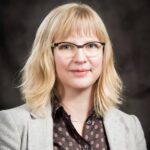
Author: Dr. Kristin Daley Mosier
The rivers I’ve known are not particularly wide, but they jump and leap around granite boulders, careen across deeply carved rock faces, and can pull down towering trees when the opportunity arises. They are not tame. Such wild rivers form high in the mountains as gravity pulls at every water molecule and droplet, gathering them together into rivulets and streams, braiding them into larger and deeper channels. Wild mountain rivers are known for their high oxygen and frigid temperatures which continue to nourish the system downstream, all the way to the briny estuaries where fresh and salt waters mingle.
Living water finds a path.
The river in Ezekiel’s vision emerges from the seat of divine presence — the temple — and from there the narrator leads us downstream to the seas and marshes and tree-lined banks. In this passage I recognize a familiar, opposite, movement. Many trails in the Cascade mountain range of the Pacific Northwest lead hikers toward the scenic waterfall or near the ridge where water first collects in an alpine lake. As humans, we often begin in the lowlands and travel up in search of the headwaters.
Living water is a divine gift.
Many of us sense divine presence most acutely when we are deep in a forest, or walking alongside a rushing creek, or visiting our favorite overlook. As human creatures, we often find a fascination with untamed spaces where we can seek a little of our own wildness.
Living water brings healing.
The vision of Ezekiel shows how the waters flowing from the seat of divine presence provide more than enough to support great swarms of living creatures in an ecosystem marked as much by its biodiversity as its abundance. This vision is a stark contrast to the realities faced by the vast majority of our waterways around the planet.
During this Season of Creation, we are invited to see for ourselves how nearby waters are ‘living’ — are they flowing freely, or contaminated by toxins? Are they replenished yearly, or being drawn down by greed? How might we bring healing?
Kristen Daley Mosier
Episcopal Theologian and Author
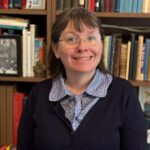
Author: Corinna Laughlin
Liturgy and Creation
The work of a liturgist can sometimes feel quite remote from creation. We typically move from our desks to our sacristies to our churches and back again. The days when we take our worship out-of-doors do exist—but they are few and far between. It can feel like creation is not in here but out there, beyond the stained glass windows.
And yet, worship and creation are intimately linked. The stuff of liturgy is the stuff of creation: water, wheat, grapes, oil, stone, wood, wax, time, light, darkness, the human body. As Pope Francis observed: “It is the whole of creation that is assumed in order to be placed at the service of encounter with the Word.” Christian liturgy looks to the new creation ,but at the same time is thoroughly grounded in this creation.
The theme for the Season of Creation this year is “Living Water,” drawn from Ezekiel 47 and the vision of the waters that feed rivers full of fish, waters that give such abundant life that the trees on the riverbanks bear fruit twelve times a year. If we look at this passage in context, we can trace the living water all the way back to its source: “I saw water flowing out from under the threshold of the temple.” The life-giving, purifying water flows from the temple, from the place that is both God’s house and our house.
As we celebrate the Season of Creation in our temples, churches, and places of worship, may life-giving waters flow from our thresholds, too. May our prayer not stop at our church doors, but move beyond them, and bring forth new life by prompting our communities to concrete action to protect and care for the earth, our common home.
Corinna Laughlin
St. James Cathedral
Pastoral Assistant for Liturgy